Today Pope Francis addressed the European Parliament during its plenary session in Strasbourg. His speech which was welcomed by standing ovations by the Members of European Parliament through whom he addressed a message to all citizens of the European Union, wishing “as a pastor, to offer a message of hope and encouragement”. Recalling the spirit of the founding fathers of Europe, the Holy Father stressed that “at the heart of this ambitious politicial project was confidence in man, not soo much as a citizen or an economic agent, but in man, in men and women as persons endowed with transcendent dignity”.
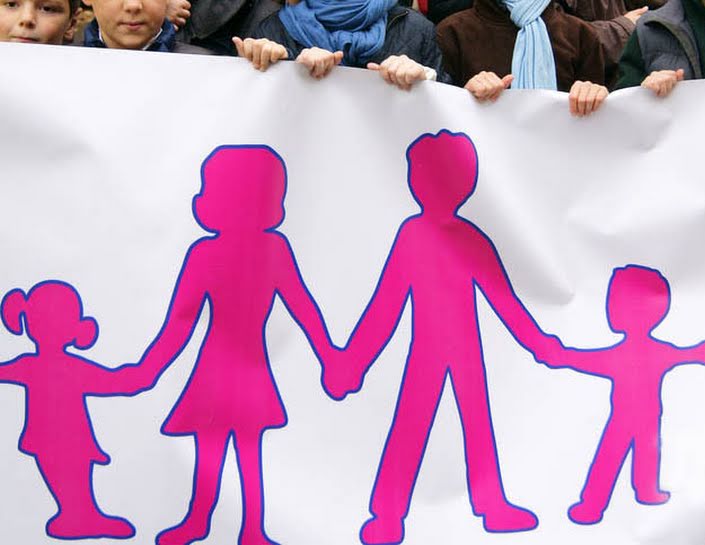
Pope Francis made several strong points about the role of family, namely saying that “To give Europe hope means more than simply acknowledging the centrality of the human person; it also implies nurturing the gifts of each man and woman. It means investing in individuals and in those settings in which their talents are shaped and flourish. The first area surely is that of education, beginning with the family, the fundamental cell and most precious element of any society.”
He also stated that without the family “the future ends up being built on sand, with dire social consequences”, underlining its importance for all generations: “stressing the importance of the family not only helps to give direction and hope to new generations, but also to many of our elderly, who are often forced to live alone and are effectively abandoned because there is no longer the warmth of a family hearth able to accompany and support them.”
Referring to the economy the Holy Father suggested that creating jobs also implies “favouring a suitable social context geared not to the exploitation of persons, but to ensuring, precisely through labour, their ability to create a family and educate their children”. The Members of the European Parliament were encouraged “to work together in building a Europe which revolves not around the economy, but around the sacredness of the human person, around inalienable values.”
Dignity of every person was a central element throughout Pope Francis speech who drew attention to what he tends to refer to as a “culture of waste”. “We encounter certain rather selfish lifestyles, marked by an opulence which is no longer sustainable and frequently indifferent to the world around us, and especially to the poorest of the poor. To our dismay we see technical and economic questions dominating political debate, to the detriment of genuine concern for human beings. Men and women risk being reduced to mere cogs in a machine that treats them as items of consumption to be exploited, with the result that – as is so tragically apparent – whenever a human life no longer proves useful for that machine, it is discarded with few qualms, as in the case of the terminally ill, the elderly who are abandoned and uncared for, and children who are killed in the womb. This is the great mistake made “when technology is allowed to take over”; the result is a confusion between ends and means”. It is the inevitable consequence of a “throwaway culture” and an uncontrolled consumerism. Upholding the dignity of the person means instead acknowledging the value of human life, which is freely given us and hence cannot be an object of trade or commerce.”
Drawing upon the image of the family Pope Francis also highlighted the need to respect the culture of each Member State, and the importance of solidarity and subsidiarity. “Unity, however, does not mean uniformity of political, economic and cultural life, or ways of thinking. Indeed, all authentic unity draws from the rich diversities which make it up: in this sense it is like a family, which is all the more united when each of its members is free to be fully himself or herself. I consider Europe as a family of peoples who will sense the closeness of the institutions of the Union when these latter are able wisely to combine the desired ideal of unity with the diversity proper to each people, cherishing particular traditions, acknowledging its past history and its roots, liberated from so many manipulations and phobias. Affirming the centrality of the human person means, above all, allowing all to express freely their individuality and their creativity, both as individuals and as peoples. At the same time, the specific features of each one represent an authentic richness to the degree that they are placed at the service of all. The proper configuration of the European Union must always be respected, based as it is on the principles of solidarity and subsidiarity, so that mutual assistance can prevail and progress can be made on the basis of mutual trust.”
* Domus Europa ringrazia il sito www.fafce.org